

The Supply Disruptions Are Finally Here
The gist

These days, I keep an eye on everything.
In particular, I watch store shelves. This week, roughly half of the meat substitutes we order are out of stock. The products aren’t the point. We’re not talking about a few things at one store. We’re talking about half, at multiple stores. It’s not just that. Other things are starting to run out, like cereal. Complaints about prices and shortages are starting to echo across the internet.
People I know are seeing the beginnings of hoarding and panic-buying. Just over the last week, almost every aspect of our lives has felt the pinch of tight supplies, more than usual. We’re fine, but we’re also not messing around. We’re topping off the dry goods we can. We’re taking inventory. Why?
Years ago, I wrote an essay about sentinel intelligence, an ability some of us have to analyze patterns for threats. It’s the fundamental difference between someone who knows when to take action and what to do, and someone who simply predicts disaster all the time until one day they get (un)lucky.
There’s nothing spiritual or mystical about it. Psychologists have studied this trait. They call it “scene gist.”
From my original piece:
Some of us can identify threats just by knowing that something's off. One study in Nature describes this ability as scene gist. As they explain, "Scene gist extracted rapidly from the environment may help people detect threats."
The shapes and contours of a landscape can trigger our threat brains even before we know the details of what we're looking at.
In these studies, participants can detect specific shapes or colors in ways that alert them to threats even before the threat itself emerges. Their brain can recognize and categorize a scene in 30 to 50 milliseconds.
At this speed, you’re not relying on facts and evidence you can present in a term paper. Your brain is making the kind of split-second decisions that mean the difference between life and death.
Those with heightened sensitivity to threats do something similar with information. Their brain makes a snapshot of everything they’ve been reading, seeing, hearing at a given time. That snapshot tells them something.
Should I worry?
We don’t need to spend all day dissecting recent headlines, but let’s lay out the gist. We know what’s up. Iran’s allies have been dealing heavy blows to Saudi Arabia, hitting their oil supply lines and refineries, and taking control of territories critical to global fuel supply. All of this happened over the last week or so, with a coordinated drone strike on Saudi Arabia on September 11. It was a strategic and symbolic attack. While Saudi Arabia has promised to repair their east-west pipeline in a few weeks, that pipeline carries roughly 5 percent of the world's oil.
Realistically, it could take a lot longer than a few weeks…
On top of that, Houthi rebels now control Yemen’s entire coastline on the Red Sea. They’ve taken strategic islands in the Bab el-Mandeb Strait, a vital link between the Mediterranean Sea and the Indian Ocean. It’s no small thing. It connects Asia, Europe, and North American supply chains. They now pose a direct threat to the body of water that carries 12 percent of all global trade.
No, we’re not talking about 10-12 percent of oil.
That’s 12 percent of all trade.
Period.
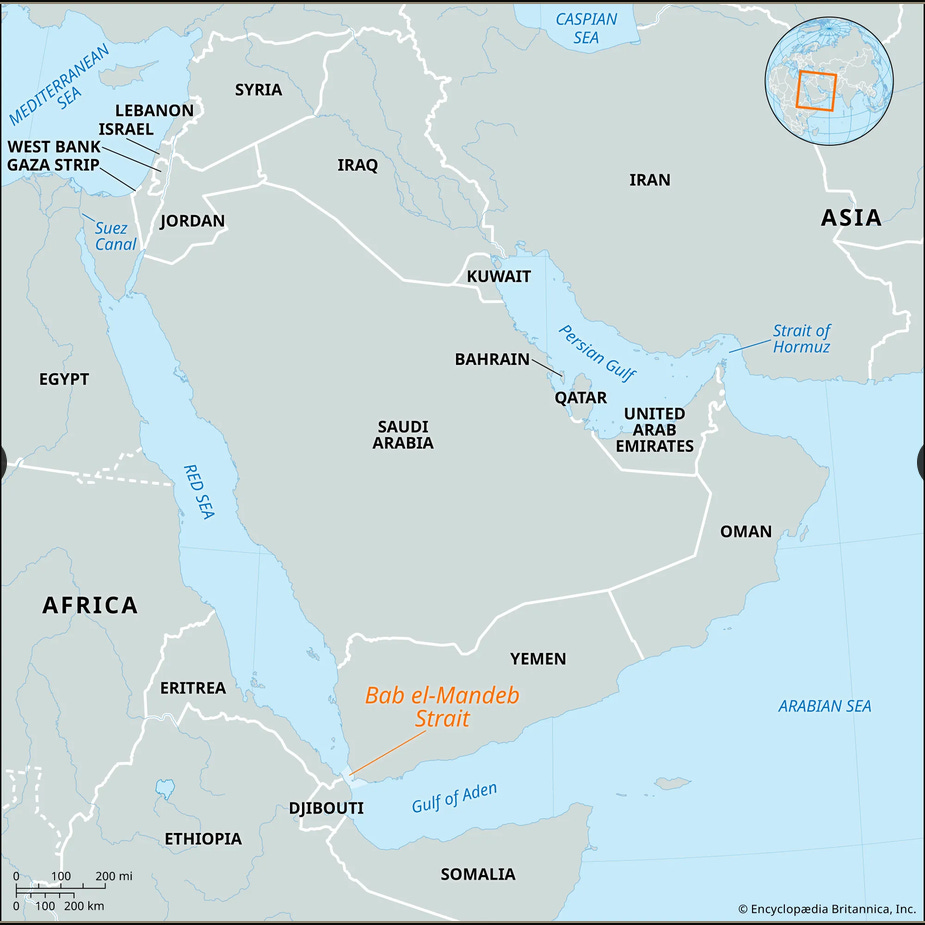
This map shows exactly why the Bab el-Mandeb Strait matters. It’s the strait on the other side of Saudi Arabia. In other words, it was the backup the world was relying on with Hormuz shut down. You probably haven’t heard very much about this strait yet. Over the next few weeks, you will.
What goes through it?
Everything.
We’re talking about liquefied natural gas. We’re talking about laptops and flat-screen televisions. We’re talking about semiconductors. We’re talking about cars, batteries, clothes, fast fashion, furniture, and toys. We’re talking about wheat. We’re talking about iron and steel. We’re talking about fertilizer.
In short:
Iran and its allies are exploding western economies. It’s exactly why the Federal Reserve recently reversed course and raised interest rates a few days ago. If you remember, Trump replaced Jerome Powell with Kevin Warsh specifically because he wanted someone to lower rates, down as low as one percent. That exact guy just raised interest rates, in direct response to what’s happening.
The U.S. is facing a critical shortage of interceptor missiles. The military still has plenty of conventional bombs, but it was the interceptors that protected American troops. Without them, they’re vulnerable. Iran also damaged or destroyed key bases in the area, making it almost impossible to resupply ships. So, there’s not much Trump can do to stop Iran now—without heavy cost.
Historic droughts and historic diesel prices are shredding farmers and their crops. It’s going to be a rough fall harvest.
What it all means:
Higher prices. More shortages. Not just a little. A lot. We don’t know how long it’s going to last. Months? Years?
What can you do?
There’s more than I can put into a single post, and that’s exactly why I started working on this survival guide—as many of you already know. It’s free. It covers food storage. It covers rain harvesting. It covers foraging and growing food. We specifically wrote this for people who don’t live on farms or homesteads. Maybe you can’t do all of it, but you can do some of it. I’m not just trying to plug a book. When threats emerge, this is my advice to you on what to do about them. You need more than just a list of foods to store. You need an entire system for survival.
This won’t be the last event that upends supply chains. Each time, the supply chains will come back weaker and more vulnerable than before. It’s time to start thinking beyond stocking up on food for an emergency. It’s time to start thinking about what you need to build systems that can get you through years of crisis. More than anything, it’s time to start realizing that the collapse isn’t some event that’s going to happen. It’s happening now.
We’re in it.
It’s completely on brand for everyone’s attention to be focused on Ed Sheeran and Pink right now. And while they certainly deserve all the backlash they’re getting, they’re not as important as what’s going on in Yemen right now. That’s big. That’s a seismic disruption. It’s good for the rest of the world in terms of unseating U.S. hegemony. It’s not so good for us Americans who are stuck living with the consequences of our inept leaders. If you have any insights or observations to add about what’s going on, please share them below.
So, that’s the gist.
Sentinel Intelligence is a reader-supported publication that also receives funding from organizations like the Alfred Kobacker and Elizabeth Trimbach Fund. You can offer one-time support here. To receive new posts and support this work on a more regular basis, consider becoming a free or paid subscriber.
