

Google Wants Our Water. All 9 Billion Gallons. They're Not Going to Get It.
There's a plan, and it's working.

In March, Google made it official. They’re going to build three giant, hyperscale data centers in western Virginia. They’ll sit down the road from the George Washington & Jefferson National Forest in the kneebend of the Appalachian Mountains. The plans are underway, even as the state trudges through its worst drought since 1941. Virginia’s governor, Abigail Spanberger, urges ordinary people to conserve water while publicly rejecting proposals to ban new AI data centers because it would “hurt the economy.” She would know: VA is home to the largest data center hub in the world, and soon they’ll be giving their water to the biggest one of all.
The Google site also happens to reside roughly three miles from Carvins Cove, a protected park and reservoir that supplies the main drinking water for the Roanoke Valley. These data centers will start pumping 2 million gallons per day (MGD) out of the cove by early 2028. Google wants the option to expand their water consumption up to 8 million gallons per day to quench the project’s thirst. They’re already planning a pipeline big enough to accommodate that.
Botetourt County officials told Google yes.
They did it in closed sessions.
If all this goes through, and Google realizes their dream, this data center site will become the biggest water guzzler in the entire world, easily surpassing the 2-5 MGD used by other giant data centers.
Even at a baseline of 2 MGD, the Google project debuts as the eighth largest worldwide. Their goal of 8 MGD puts them in the lead. They’ve also recently bought the entire output of a nearby wind farm, which falls around 600 megawatts on any given day. Google has already said it probably won’t be enough. In fact, the entire wind farm might not even cover half the electricity demand. They’re going to pull the rest of it from local utilities.
The cove’s treatment plant can generate 10 million gallons of daily drinking water right now. By 2030, Google’s gigantic data centers could be gulping down 80 percent of that. Before the data centers, experts projected that our water supply would last into the 2060s. It includes a backup spring, forming a total of 9 billion gallons or more. Now, we’re on track to run out by 2030. Officials with the county and the water authority have promised it won’t come to that.
People have their doubts.
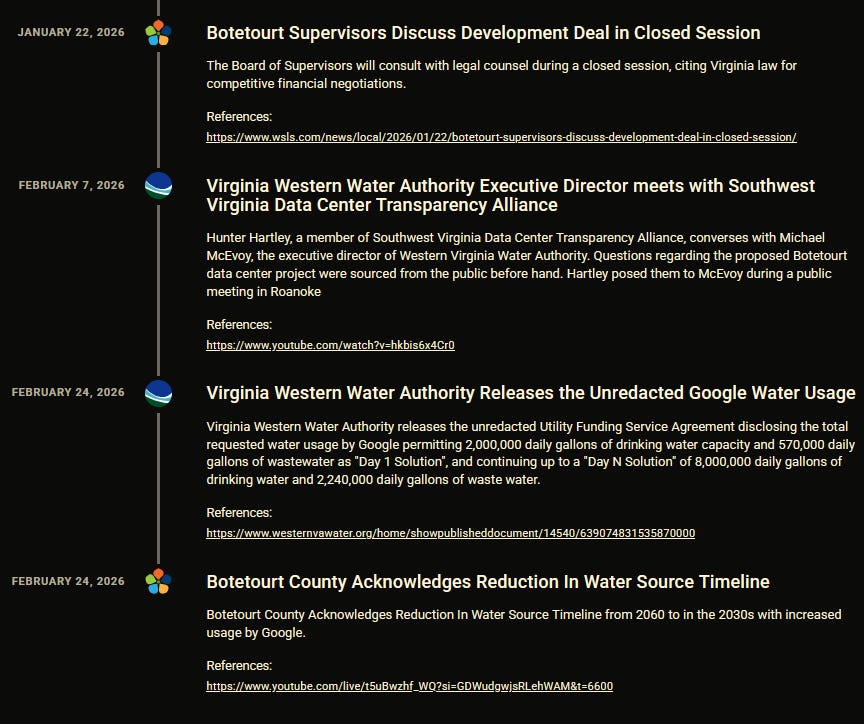
Fortunately, local journalists and lawyers pressured the county to give a more accurate timeline, and that’s when they admitted the truth: we’ll need more water by 2030. In February, an alliance of water conservationists in Virginia compelled the water authority to finally release a full, unredacted agreement on Google’s water usage. The spear: An indie journalist named Henri Gendreau of The Roanoke Rambler filed a complaint against the water authority, and a circuit court judge decided in his favor, requiring the full release. You can read that agreement here. (You might have to open it in Chrome.) I’ve also uploaded the full document:
This agreement explicitly grants Google up to 8 million gallons per day, under its “Day N Water Solution Plan.”
The exact wording:
“The WSP will analyze all aspects of water supply planning… in order to assess and evaluate viable alternative water supply sources and needed water supply infrastructure in order to meet the Day N Water Solution, which the Parties understand could require up to eight million gallons per day, or six million gallons per day above the Day 1 Water Solution, without impairing the utility’s ability to meet the current and future water supply capacity needs for future system demand.”
In essence, at some vague point in the near future, our water authority will do everything in its power to help a tech giant use more water than our entire valley population. They promise it won’t hurt us.
Pinky swear…
Google has a poor track record of sticking to their original water usage agreements. For example, their data center in The Dalles, Oregon area tripled over the course of five years. Ultimately, Google wound up hoarding up to 40 percent of the city’s drinking water. The city even tried to sue a local newspaper to keep the public from finding out about it. You can find similar stories all over the country. Google moves in and starts using up everyone’s water. Local officials bend over backward to try and please them, but it’s never enough.
Let’s stop and summarize:
Before Google started barging in, the Roanoke Valley enjoyed an abundance of water. Now authorities are scrambling for a way to feed three giant data centers that will gulp down more than the combined consumption of three entire counties. It’s a massive sign of corruption and incompetence.
The water authority was trying to hide the full 8 MGD amount, because they knew it wouldn’t go over very well. They knew they didn’t have a sound strategy for protecting our drinking water, but they were going to let Google build the data centers anyway. It amounts to a hostile takeover of our region’s entire water supply, with only the vaguest of plans about securing more water for ordinary residents. They could solve the problem preemptively, but instead, they’re going to open the site and then worry about the water shortages later.
Many state leaders are doing less than the bare minimum to address the drought crisis. For example, Virginia will soon require data centers “to try and limit their water use” in “water scarcity areas.” They have to “show they’ve minimized the use of any water for cooling purposes” by 2032. Look at this map and tell me what parts of the state aren’t experiencing “water scarcity.”
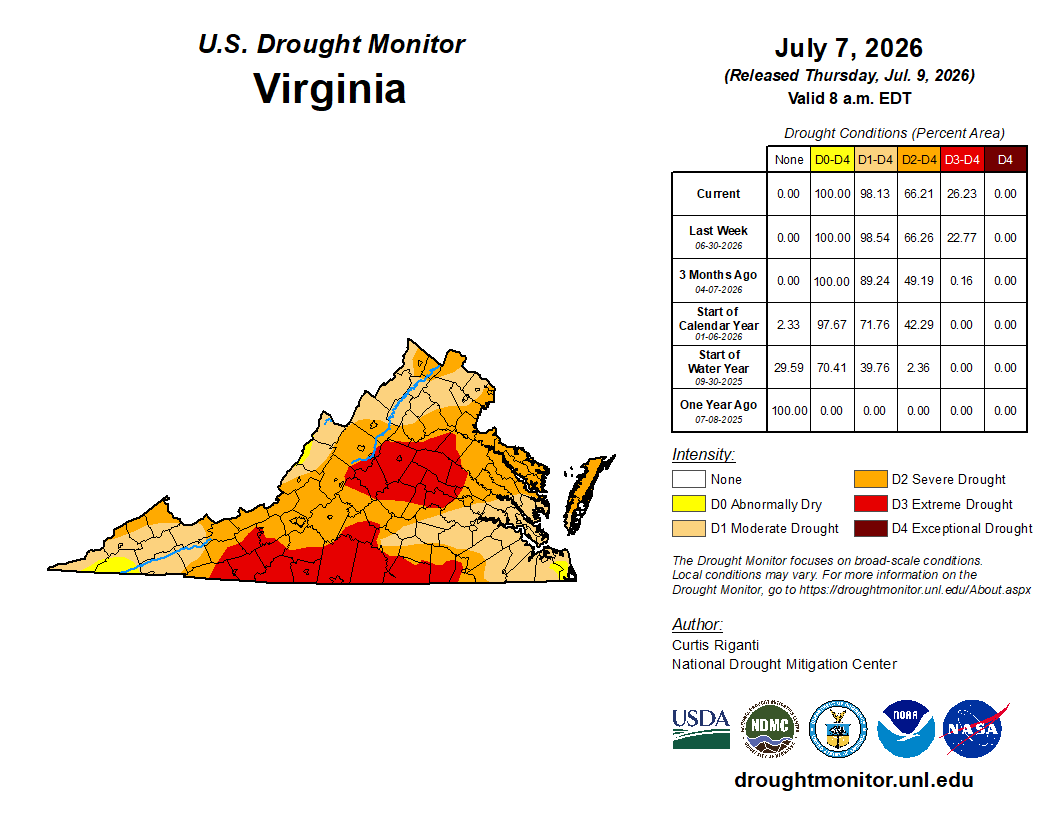
And yet, the governor has tried to introduce amendments to bills that give these data centers more leeway in using water for evaporative cooling in water-scarce areas. Correct, she wants to make the laws nicer to tech giants. Neither the Virginia Department of Environmental Quality (DEQ) nor the governor currently claims the authority to shut down data centers, even during severe droughts.
There’s some good news:
Nearby cities and counties that rely on the cove are speaking up and mobilizing resistance. Action groups are putting pressure on the governor and state assembly to do more. That’s just the beginning.
The Southwest Virginia Data Center Transparency Alliance and the Botetourt County Data Center Information Group have mounted a legal challenge. They’ve retained Chap Petersen & Associates. The firm just recently stopped The Prince William Digital Gateway, another massive data center corridor that would’ve dropped up to 37 data centers on the edge of a Civil War memorial park in northern Virginia. Pestersen and his team beat them. The team included law partners, homeowners associations, historical societies, environmental councils, national parks associations, and conservation alliances. From The Prince William Times:
"We stood up to some of the largest companies in the world, and we were able to pull off essentially a miracle,” Petersen said Thursday afternoon.
What can you do?
Well, we need to make this a national story. It’s a big deal. What happens here will provide a template for what happens across the rest of the country. We’re at a pivotal moment in the legal battles against data centers. The tide is turning in our favor. A victory here will resonate across the country and send a clear signal to tech giants that they’re not going to sneak in and take our water. They’re not going to hoover up our electricity and drive up utilities. They’re not going to poison our parks and forests with their massive backup diesel generators. They’re not going to torment our neighbors with light and noise pollution.
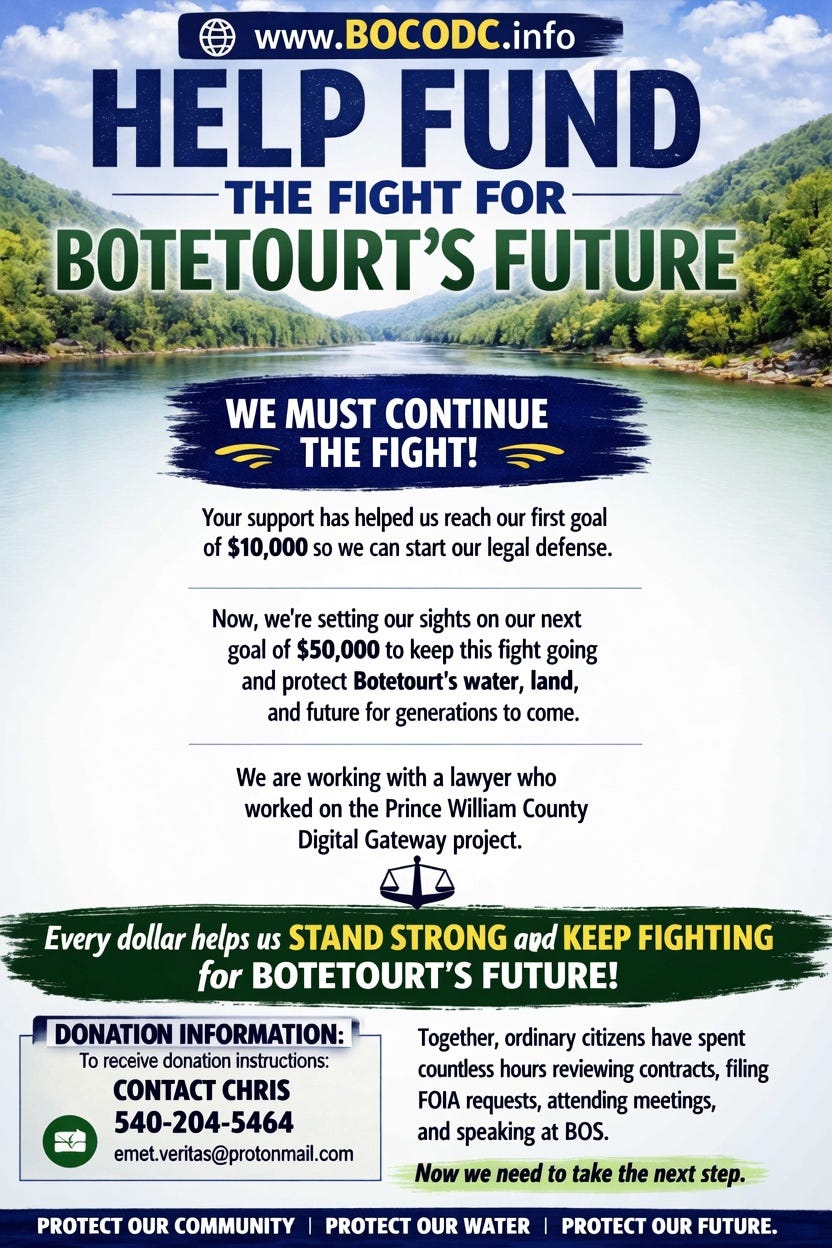
You don’t have to share my post if you don’t want to, but you could share this one, or this one, or this one. You can also donate to the legal fund for Chap Petersen & Associates. They’re already doing work on the case. These cases succeed because they don’t target the tech giants directly. They contest the zoning law changes.
Finally, support the local alliances and independent journalists fighting data center expansion in your towns and cities. Sadly, when we were researching this piece, we learned that The Roanoke Rambler came under new ownership and drove off their small underpaid staff. They’ve largely ceased publication. This paper was essential in compelling the truth on Google’s water usage.
Now, they’re gone.
But: As Erin Brockovich has written, movements to stop data centers are winning. Communities are banding together.
A hundred years ago, lumber barons stripped Appalachia bare in their quest for money and power. They clearcut entire forests. They drove out local sawmills and brought in massive engines of destruction. It’s taken generations to restore the land. Now a new group of profiteers and tycoons wants to destroy it all over again. The question is whether we let it happen.
We’re going to stop tech giants from ruining our future. Not just here. Everywhere. We’ll win, even if we have to do it county by county. If you make a donation, please drop a comment down below. It would be great to keep a tally. Also drop a comment if you’re involved with a group fighting a data center.
Billionaires don’t own this planet.
And they don’t own us.
Let’s show them.
Sentinel Intelligence is a reader-supported publication that also receives funding from organizations like the Alfred Kobacker and Elizabeth Trimbach Fund. You can offer one-time support here. To receive new posts and support this work on a more regular basis, consider becoming a free or paid subscriber.
