

Want a Little End Times Solar? It Just Got A Lot Easier. Don’t Be The Last to Know.
Get it cheap before hell freezeth over.
Get it cheap before hell freezeth over.

Get it cheap before hell freezeth over.

So I spent months fidgeting with terminal ends, fiddling with cables, and squinting at T-fuses. I was going to write an epic tutorial on building your own micro-grid in the second edition of my guide. Then I looked at Bluetti's new batteries and threw it all on the back burner. And I couldn’t be happier.
I’m still making it, but…
You probably just want a backup battery with some solar panels.
Now you can get it, without having to translate complex instructions or hang your head in shame for getting a prebuilt, all-in-one model. While the cost of everything else has gone up, up and away over the last few years, the cost of solar panels and batteries has cratered. It’s a macroeconomic miracle, a windfall in your favor, and I would take advantage of it while you can.
And while I grasp the argument that solar panels and batteries are evil and all that, they make great Christmas presents. Nothing says “I love you and I don’t want you to die in the apocalypse” like a backup battery.
Here’s why:
Back in the olden days of 2022, you’d pay seven grand for a 5kWh all-in-one battery bank to run a few appliances during a power outage. That’s when it made sense to learn how to build your own micro-grid. Now?
It costs half that much.
What happened? Well, companies like Bluetti, Eco-Worthy, and Wattcycle became masters of their own supply chains. They scaled up their factories. They cranked out a glut of equipment that’s more efficient. There’s massive competition right now, and that’s great for consumers. Now, all of the components you had to connect by hand come in these all-in-one units. It’s standard.
It’s simple.
There’s simply zero practical, immediate advantage to building your own solar backup battery system anymore.
You’re free.
You’d only DIY a solar setup now if you were truly interested in developing the long-term skills or becoming an electrician. If you’re just not into that, then you don’t have to worry about it anymore. Focus on growing food. Focus on learning Ham radio. Literally anything else. In the early 2030s, there’s going to be little point in crawling through landfills looking for old LiFePO4 batteries.
That doesn’t mean there’s nothing to learn.
You still need to know the basics of electricity. You need to know things like series vs. parallel connections. You need to know how to read the specs on a solar panel, a generator, a battery. You still need to know the difference between amps, voltage, and watts. This makes you a smart consumer. But gone are the days when you had to match a charge controller to an inverter.
So, what would I get?
If you’re preparing for a power outage during an ice storm, a flood, a heatwave, I would get something like the Bluetti Apex 300 + B300K. That sounds complicated. It’s not. The Apex 300 is what they call a “generator” or power station. It converts DC power from a solar panel to AC so you can run AC devices. The B300K is an add-on battery that connects to the Apex 300. It doesn’t have any AC ports. It only connects to Bluetti’s power stations. Why get both?
They give you more than 5kWh.
That’s good.
That setup costs $2,600 right now. As we’ll discuss in a minute, if you get it during a sale, the price typically drops to around $2,000. You would spend almost that much building a DIY equivalent, just in parts.
It would take you 20-40 hours.
The Apex 300 can accept up to 30 kW input from portable solar panels. That’s a huge leap over the 1kW bottleneck from just a couple of years ago. Solar panels have also made a leap forward. Back then, you were stringing together several 250-300W panels. Now you can hook together two 500W or 800W panels and run some serious juice to your batteries. They charge faster. It’s really no contest.
Plugging up 2 big panels? That’s pretty simple now. You just have to follow the factory instructions. If you can read, it’s hard to mess up.
Everybody is going all-in-one.
My family has used Bluetti for years. They’re solid. But they’re not the only game in town. Check out Eco-Worthy. Check out Wattcycle. Check out Pecron. Check out EcoFlow. Check out Jackery. Check out Goal Zero. Check out Renogy. Check out Anker. Check out DJI. Check out Dabbsson.
EcoFlow usually offers the latest tech.
Anker offers the most reliability
Bluetti offers the best deals.
Jackery offers the lightest.
For these companies, their products are almost always on sale. It’s a bit of a gimmick. You have to wait until November or June for the real sales.
One is coming up…
It’s easy to dismiss backup batteries as a luxury.
We’re talking survival.
Heatwaves and winter storms don’t just make you uncomfortable anymore. They kill. With batteries and panels at 5-10 kWh capacity, you can truly run portable heating and cooling units without worrying as much about draining them. Pair them with common sense survival strategies, and you’ve got a real plan.
EcoFlow makes a heater and cooler that runs on a portable solar battery. It’s called the WAVE 3. Unlike a regular heater or a window unit, the WAVE 3 is designed to ramp up gradually. No big power surges when you turn it on.
That’s a game changer.
There’s one little catch with these all-in-ones. It’s hard to keep the batteries inside and charge them at the same time. So in the last version of my guide, we came up with a little workaround for that: the passthrough panel.

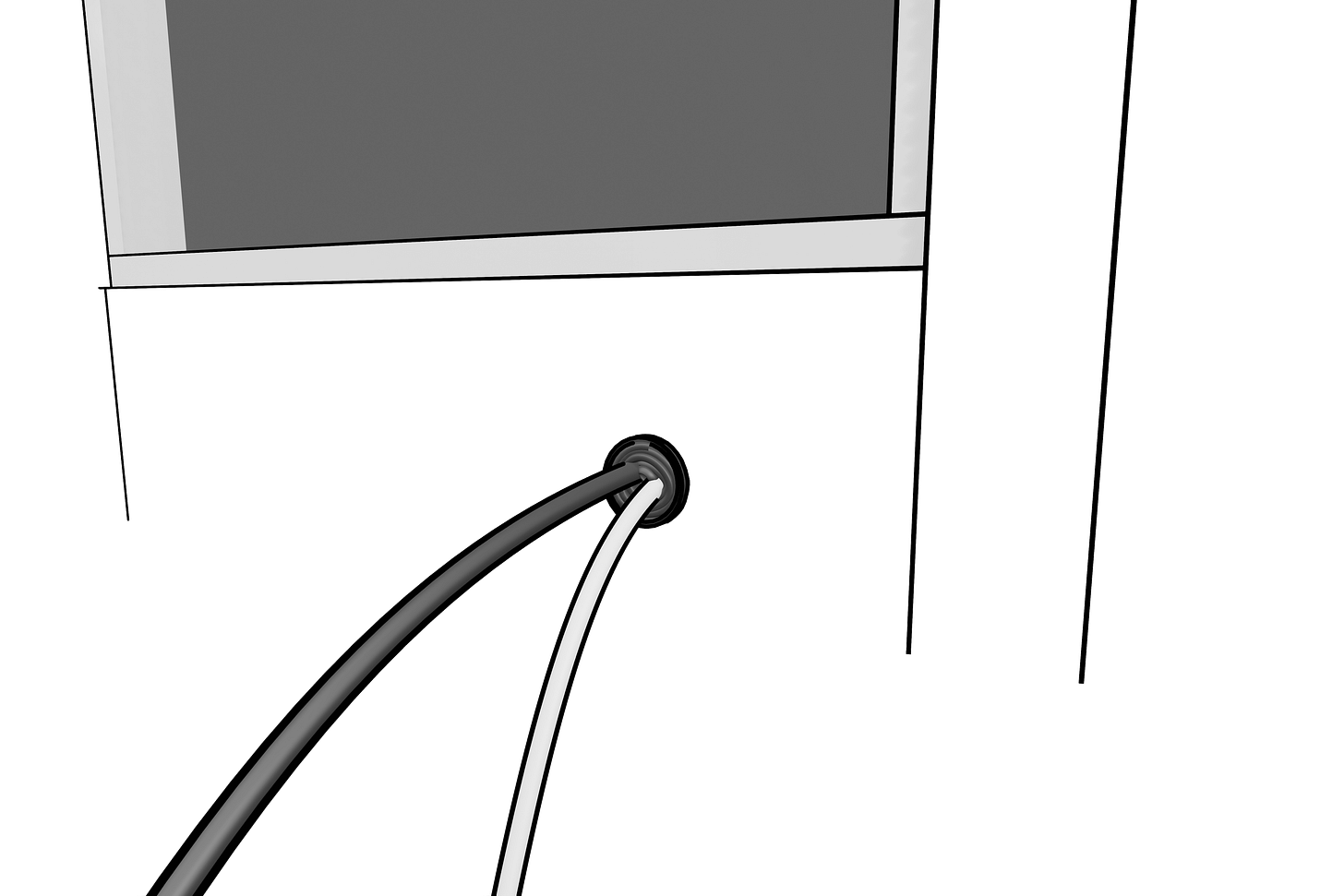
You just need a piece of XPS foam, a hole saw, and some weather tape. Now you can hook the solar panels up outside, run them inside, and…
Charge your power station.
In early or mid November, these companies will start their Black Friday sales. You’ll probably get this equipment at a heavy discount.
If you really don’t want to wait, that’s up to you.
Reminder:
I’m not dropping any affiliate links. I’m not raking anything in through corporate sponsorships. That’s not why I’m doing this.
When a derecho crashes through your neighborhood with 70 mph winds and you’re left without power for 2 weeks, there’s endless reasons why you’ll want to keep at least one room in your house climate-controlled. You’ll want to charge a communication device. You’ll want to run a chest freezer.
Until recently, I was still under the impression that portable solar was mainly for glamping, and that it wouldn’t be practical on a budget. I had no idea how much things have changed. It’s a different world. So, you don’t need to break your budget for rooftop solar. You also don’t need to get an unofficial degree in electrical engineering to rig something up that’s fast and safe.
When the ice storms hit, when diesel and kerosene cost as much as five golden rings, four calling birds, three French hens…
This lets you stay alive. No hassle.
If you’re interested:
I’ve started working on the second edition of my guide. You’ve got about 24 hours left if you want to back a full print edition. It’s going to have more information, more projects, more illustrations. It’s going to include different strategies and tips on leveraging these all-in-one battery systems. It’s going to be ready by May. I’ll be sure to post updates and info along the way.
But you don’t have to wait to get backup power.
You can have it now.
Escape wishful thinking.