

I’m Never Going to Finish My Survival Guide
And more thoughts on AI slop

Last year, something occurred to me.
I needed to write another book.
This book would be different from all the other ones I’d written: novels, reference guides, edited collections, graphic novels. This was going to be a survival guide, a collection of everything I’ve learned over the last four years. It was going to cover the essentials of food storage, bugout bags, rain harvesting, growing food, foraging, herbal medicine, and a lot more. It was going to be the kind of guide I wish I’d had when I first started prepping.
Some of you know:
Back in 2024, I left a tenured position in academia for several reasons. More than anything, it felt pointless to continue submitting articles to journals and publishers about obscure topics while the world turned to ash right in front of us. It felt pointless to sit around in endless meetings and Zoom calls, debating “what’s best for students” without asking them—and often ignoring them when they tried to tell their professors what they really needed.
Long story short, it took me three years to write this guide. It’s one of the most challenging, most ambitious, most difficult things I’ve ever done. I spent three years learning Blender, one of the most powerful but also one of the most difficult pieces of software in the world. Yeah, three years.
For three years, I spent most of my free nights in front of a computer, learning about mesh topology, shader nodes, geometry nodes, grease pencils, and line art modifiers. I learned about rigging and posing characters. I learned about shape keys. I learned about blend modes. I learned about path curves and bolt factories. I did this while raising a kid and holding down two jobs, three if you include the countless hours spent learning how to build sustainable survival systems.
In the end, I was able to produce this:
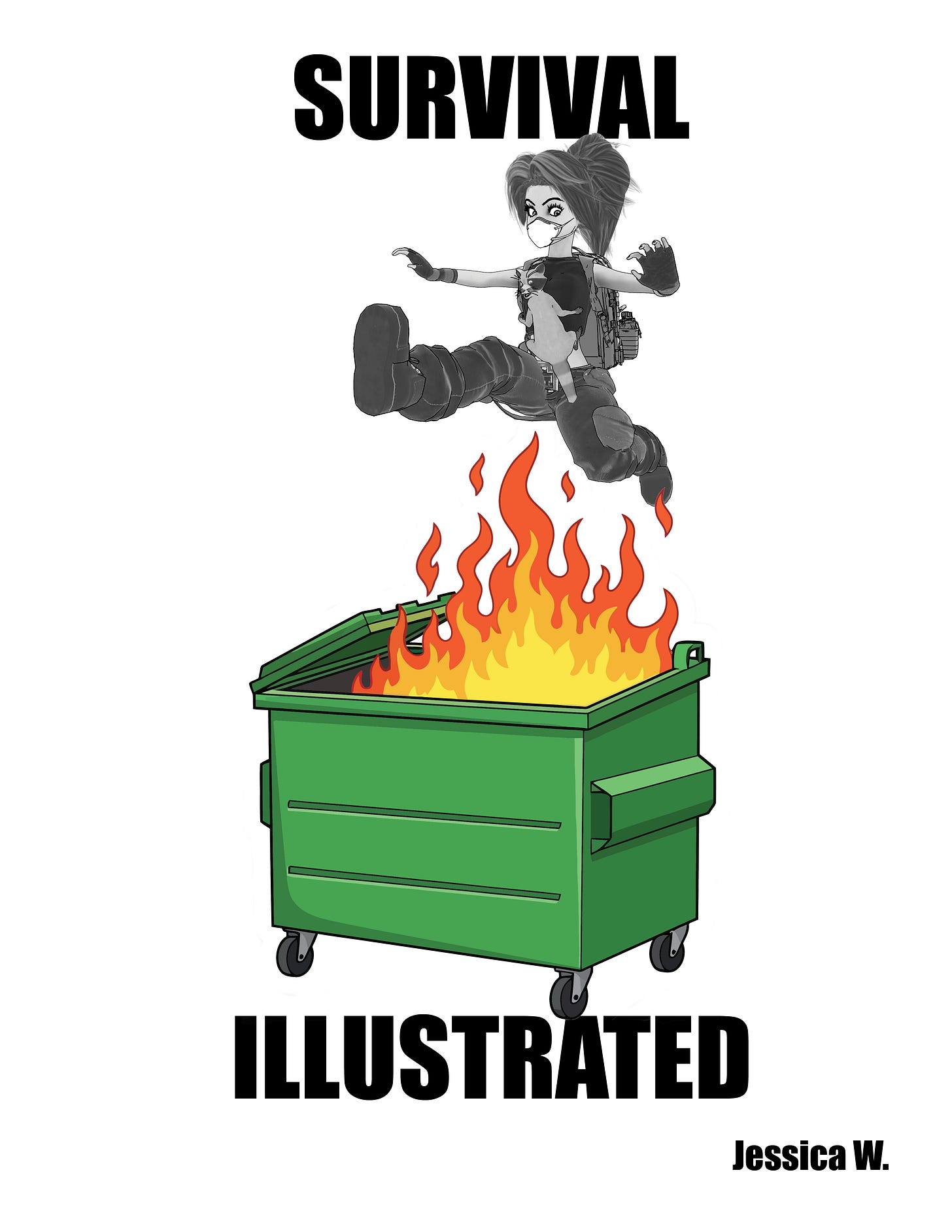
It’s more than 200 pages. It’s free. You can also order a print version.
For the print version, go here.
I’m sorry there’s no dramatic, AI rendered images of urban ruins. There’s no shadowy figures holding assault rifles. For my guide, I decided to do something different. I decided to make prepping fun.
Even cute.
I’m sorry if you don’t like the font. I deliberately chose something that looks casual, something that doesn’t take itself too seriously. I can’t change the font right now. That would require a pretty extensive redesign.
This guide will never be done. I’m never going to finish it. Why? Because the survival guide in my head—the perfect survival guide—is 450 pages. It talks about growing antibiotics from soil. It includes instructions for communities on manufacturing medicines like insulin. It provides a detailed breakdown on Morse code and Ham radio operation. It shows you how to completely disassemble a bicycle. It shows you how to wire an entire cabin from scratch.
That’s why I’m never going to finish it.
The guide will always feel incomplete. It’s a growing guide, meant to reflect a lifetime of learning, a lifetime of reclaiming the forgotten skills that weren’t passed down to me from older generations. No, not horseback riding. No, not trapping game. These aren’t solutions for most of us. They’re distractions.
They’re false comforts.
So I’m going to keep working on it. I’ll keep releasing editions with new sections. I’ll keep posting about my journey online.
It’s been a rewarding but frustrating journey. On the one hand, I’ve solved problems that felt almost impossible, like filtering rainwater from a shingle roof and figuring out how to make an affordable composting setup for basic sanitation during a longterm emergency… in the suburbs.
Believe it or not, that wasn’t the hardest part. The hardest part was overcoming all the naysayers, the ones who insisted that I couldn’t do it, or that it wasn’t worth doing for various reasons, or that my illustrations weren’t good enough, or that it had already been done and I was wasting my time.
I feel good about this edition.
On the other hand…
Honestly, it’s been a little demoralizing to watch AI slop artists slide into this platform and start generating content about the topics I’ve been researching for years, raking in ten times more praise despite their heavy reliance on artificial intelligence for their prose and their illustrations.
For what it’s worth, there’s some extremely cool AI programs that add shading to your artwork and give it a smooth, professional finish. I really wanted to use them for my guide. I didn’t. This is what restraint looks like. This is what it looks like not to use AI, even when you really, really want to rationalize it.
I wasn’t going to say anything, but…
People have started recommending these articles to me. They’ve started asking me for my takes on their affiliate links. They’ve said they’re willing to spend forty bucks to learn about “water freedom,” even though I’m offering that knowledge for free. (It’s just a dehumidifier, folks.) The irony of it all? When I first started writing seriously on Substack in 2022, I was accused of engaging in deceptive affiliate marketing to promote nose sprays and supplements. I wasn’t. And yet, prominent accounts refused to promote my work because they were convinced I was a grifter. Now AI slop artists openly engage in that behavior, and nobody calls them out.
These writers don’t have to worry about how they’re perceived. For the love of god, one of them uses the back of his head for a profile photo. Our readership happens to overlap a good bit, and I’ve noticed something. People are quick to come to their defense over their use of AI. They’re more than willing to overlook the inaccuracies, the hasty generalizations, the contradictions. They’re entirely invested in pulling out the one or two things they found admirable.
It must be nice…
Meanwhile, the same group wastes no time expressing their shock and disappointment at me when I violate an expectation, yanking support when I say something they disagree with, or when one of my characters promotes “unhealthy body types.” And yet, they willfully overlook or rationalize the moral and ethical dilemmas presented by the slop artists, writing about social collapse while employing the very technologies that are accelerating that collapse. Hey, I’m all about flexible moral standards. Could we try to make them equal?
They don’t challenge the problematic assumptions underlying articles that declare entire regions of the country “bad places to be when collapse begins.” They don’t call out the privilege of thinking like that.
Fine, I will.
By the way, the premise of my work is that while most of us can’t control where we live, we can take ownership and agency over our survival. Prepping and survival aren’t about running away from where you are because it feels dangerous. It’s about investing where you are.
One of the biggest lessons in my guide isn’t explicitly stated, but it’s there on every single page. It’s something I learned when we moved across the country. You don’t escape collapse. Not even a little. You simply move into a different set of problems. We thought we were getting away from droughts, only to end up in the middle of one of the biggest droughts in history in one of the last places you’d expect. As far as I’m concerned, it’s a futile endeavor to ask AI to find all the places you shouldn’t live during the collapse of civilization. Instead, learn about where you are and come up with ways to deal with those problems.
Does population density have to be a liability?
What if you decided to make it a strength?
If more people were invested in changing their surroundings, working together, cooperating, instead of just paying lip service to those ideas, then perhaps half the country wouldn’t be on track to become uninhabitable. The idea of simply leaving or abandoning a place once it becomes too difficult is, in fact, one of the primary reasons things have gotten so awful. People leave this or that city. They leave this or that country. They take all of their assumptions and entitlements with them, thinking that they weren’t part of the reason everything went to hell in the first place. Well, you know what they say: “Wherever you go, there you are.”
My guide isn’t about fleeing. It’s about staying put.
As for the newsletter:
The first comments I often get on my articles now are people reprimanding me over my word choice or yelling about aspects of a platform I have no control over. They tell me I shouldn’t “worry” about securing my doors, even though I already did it and my point was how much I learned. They tell me I’m fragile for wanting to filter my rainwater. Why not just drink the dead frog fountain?
“It will strengthen your immune system,” they say.
People cancel. They open disputes. They send long emails lecturing me on what I’ve done wrong. They call me names. The irony is that these aren’t trolls. These are people who’ve benefited from my work. They preface their attacks by telling me how much and how long they’ve enjoyed it. And you know what I think? Gosh, these are the people who want to build community???
Well, good luck with that…
Something really interesting happened yesterday. I posted a link to my new guide, and you know what one of my readers did? They didn’t like the post. They didn’t say thank you or congratulations. They shared a link to a slop article and said I might find it useful. What am I supposed to do with that?
Thanks, I guess.
Anyway, I was going to end this article by begging for support. But I don’t think I’ll do that. The work either speaks for itself, or it doesn’t. Either way, I’m going to keep working on the guide. I’m going to keep calling out nonsense when I see it. I’m going to keep telling unpleasant truths, even when it costs me a quarter of my subscribers. There’s no other way for me. It’s this, or nothing.
So could you just let me know:
Do you like the guide?
If you like the guide, if you think it’s worth continuing to work on and improve, could you take a few seconds out of your day to let me know? Could you hit a button on your mouse or your phone? Could you type a couple of sentences? Although we’re all supposed to be Clint Eastwood-style rugged individualists, and we’re not supposed to care what anyone thinks, I’d like to remind everyone that even Clint Eastwood cares what people think, or he wouldn’t have kept releasing movies. He wouldn’t have gone on all those talk shows to promote them. He wouldn’t have accepted all those awards and all that money. I’m not supposed to care?
The entire point of art and teaching is other people, so what they think actually kinda matters—for a lot of different reasons.
Take care,
Jessica
