

Learn to Make This, and You'll (Probably) Always Have Clean Water
I'm experimenting with designs.

As you might know, the UN recently announced that the world has entered an era of “global water bankruptcy,” years ahead of schedule. Meanwhile, vast stretches of Europe and North America are going through the worst droughts in their recorded history. It’s safe to say, we’re running out of water.
You don’t need a crystal ball to know what severe droughts will look like in the U.S. Go back through history. Look at the Dust Bowl of the 1930s. Read about the Texas Drought of the 1950s. It’s scary stuff.
We need a plan.
So, I’ve spent the last few weeks digging hard into solutions. My illustrated survival guide covers the very basics of setting up a dew harvester, but now I’m improving and scaling up the design. For many of us, you can count on reaching a point in the future when you’ll need more than a few ounces.
Rain harvesters fail when it doesn’t rain. Meanwhile, most regions around the world produce dew on a fairly regular basis. Even if the weather conditions don’t reach the exact dew point, you can use materials that capture dew anyway. Civilizations and small communities have been harvesting dew for millennia, even in the desert. It’s a very good way to make sure you don’t die of thirst.
When I was going back over my research for dew harvesting, I kept thinking about a structure called the warka tower, an open-source project.
Here’s their site.
Communities have built these towers all over the world, in water-scarce regions. The project goes back more than ten years, to about 2013, when the project’s engineers started putting out their first designs. You can build them to almost any size, small or huge. The larger ones can generate dozens of gallons of water per day. I’ve paired that with other research I’ve done, showing that black HDPE plastic (high-density polyethylene) works great for catching dew.
Guess what trash bags are made from?
Yep, black HDPE plastic…
I’ll be trying out a range of materials, including raschel netting, but if trash bags work, then that’s something in ready supply, and something that people pretty much anywhere in North America can use.
I’ve made a few different kinds of dew catchers over the last year. They work okay, but not great, not enough to fully replace your water source during a real emergency. But recently, I came up with a better design.
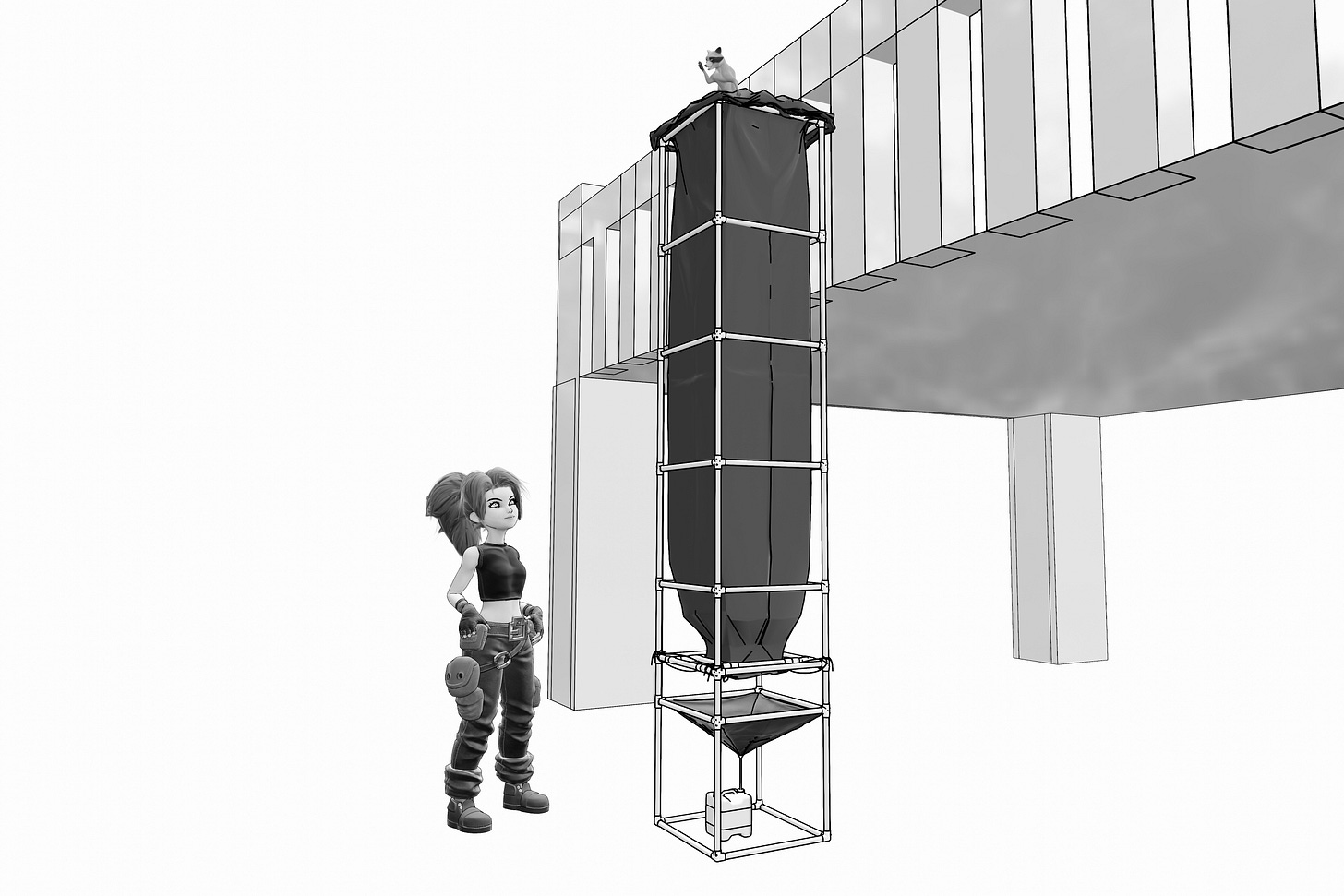
I’ve made a small version of this, and it works.
Now, I’m making the tower version.
Soon, I’ll be posting full instructions with illustrations. For now, I’ll just lay out the basic premise and a list of parts:
- Get a bunch of 2 ft PVC pipe, 3/4 inch works well.
- Get 3-way and 4-way pipe couplings.
- Build the outer frame (shown above).
- Cut some of the PVC pipe into shorter lengths. Use them to make an inside square, to help funnel the big bag.
- Make a black HDPE funnel bag by cutting a big trash bag (40 gallons or bigger) diagonally, as shown below). Measure the bottom side so that it matches the height. That way, you have a square funnel.
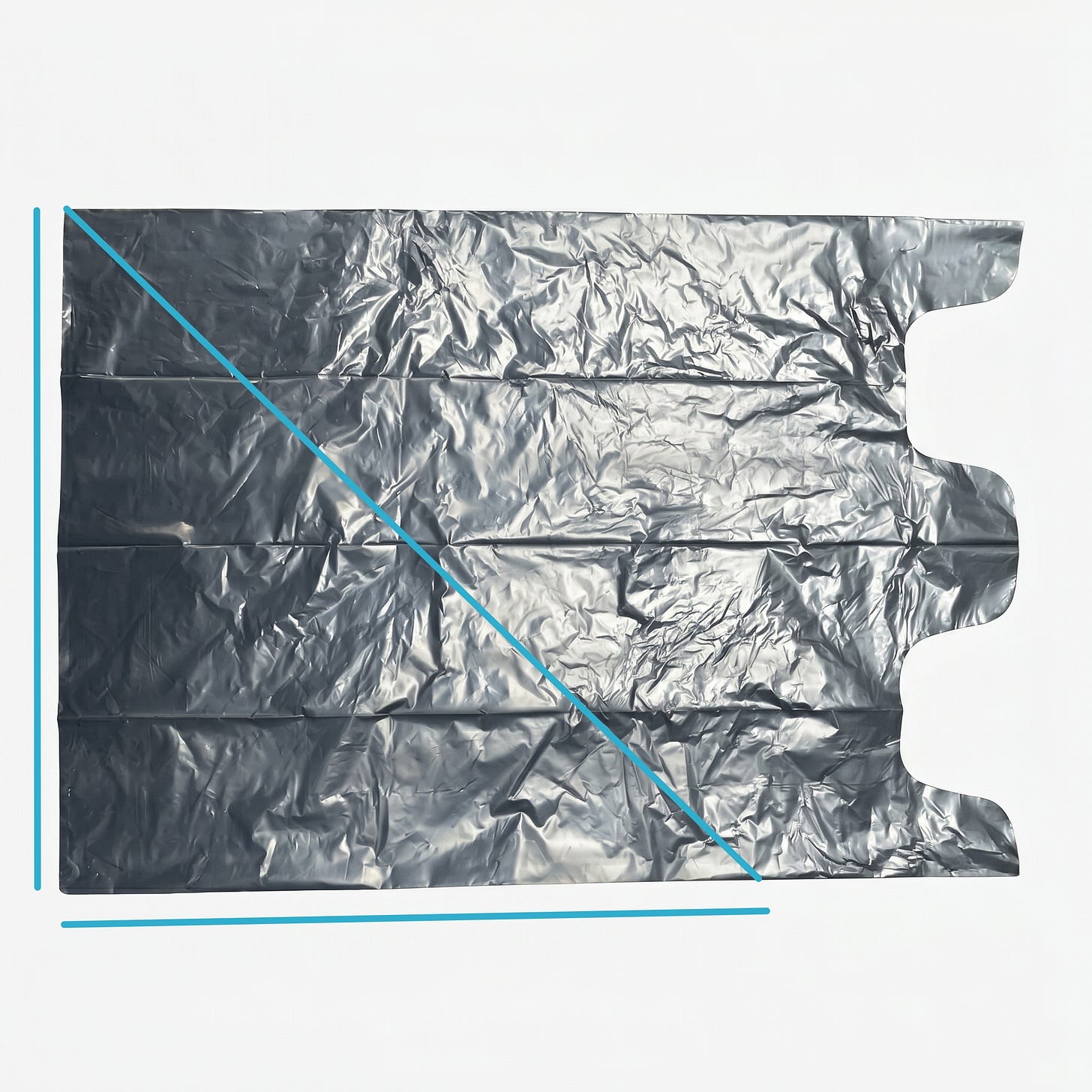
- Punch holes in the ends, so you can lash them to the PVC structure with paracord or shoelaces, whatever you want.
- Before you lash the funnel bag:
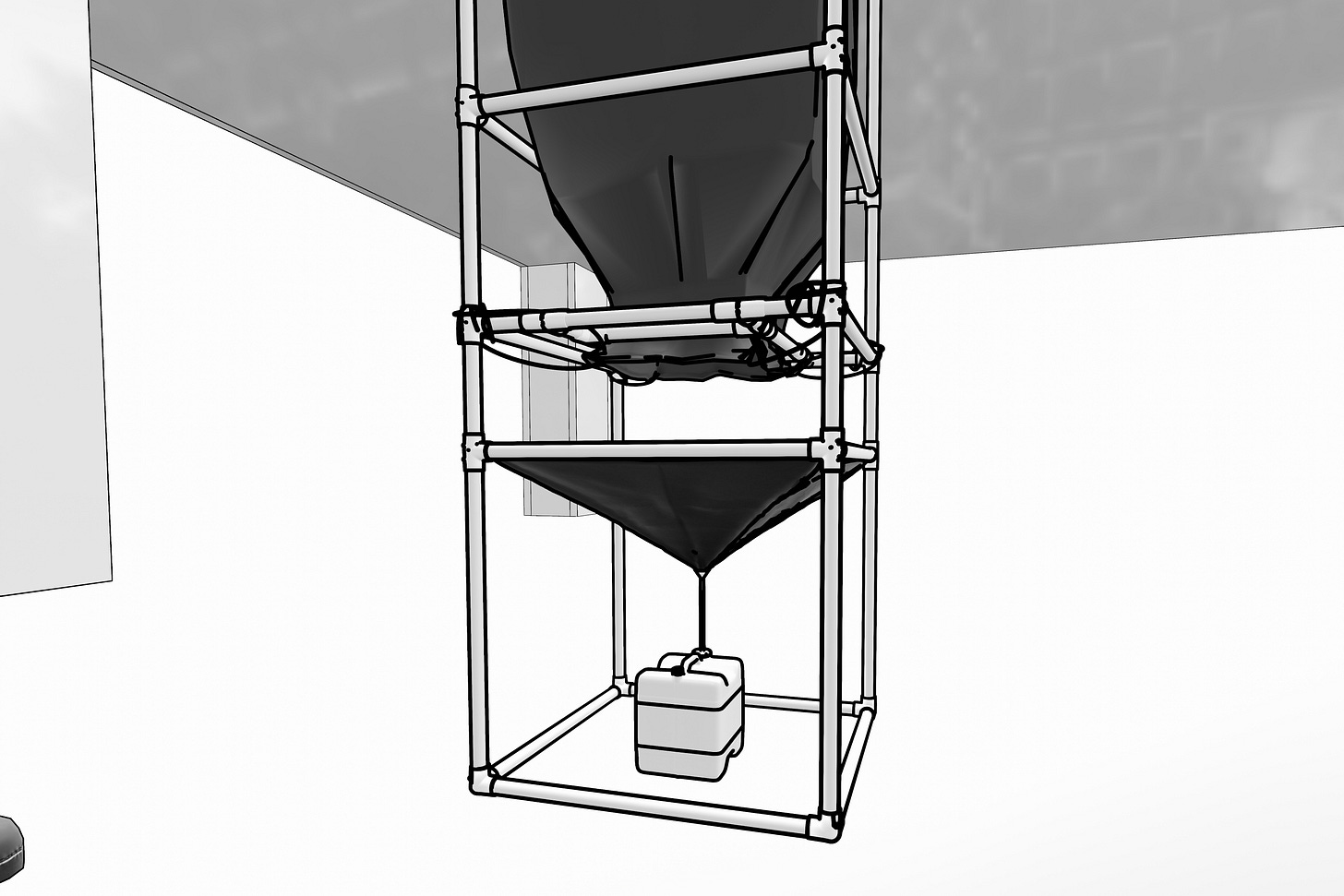
- Get a plastic funnel, not too big, not too small. Spray the inside with a good adhesive spray. Put the corner of your bag into the funnel. Pack it with damp sand. That will keep pressure uniform on the bag, so that corner dries nice and flat along the inside of the funnel.
- Punch a hole in the bottom corner of your funnel bag, once it’s dried to the plastic funnel. Now you have a giant funnel with a nice, structured hole for dew to flow through. You can sit the plastic funnel end into any rigid plastic PVC pipe, and run the pipe into pretty much any container. (I tried a flexible hose, but it wouldn’t stay straight and kept janking up the shape of my funnel.) For my prototype, I used 3M max strength adhesive spray. I know it’s not foodsafe, but we’re just making a prototype. Besides, you’re going to be filtering this water anyway before you drink it. Also, the spray is going outside the bag. It’s not going to be inside the bag, and it’s not likely to leach through anytime soon. I’ll be looking for food-safe spray adhesives for the final version.
- You might wonder why you’re gluing the bag to the inside of the funnel instead of the funnel to the inside of the bag. My reasoning: You don’t want a lip, bulge, edge, or anything else inside your dew funnel. You want a completely smooth funnel that tapers straight into the PVC pipe. At least, you want to get as close to that as possible.
This is what it looks like when you’re done with the first part:
- For the big bag: Take several big trash bags. Cut the bottoms off. Tape them together. Now you have one very big dew harvesting surface that fits inside your PVC structure. I’m wondering whether it’ll help to turn the big bag inside out when I’m done, so the tape goes on the inside.
We’ll see…
- Poke some holes in the bag, and secure it to the PVC structure with paracord, string, whatever you want.
- Secure the PVC structure to a deck, a gutter, a tree, whatever you think will help steady it during wind gusts, etc.
- You can also stake it down.
That’s my plan.
We’ll see how it works. I’ll update everyone on the process and results. In the meantime, feel free to make your own version or suggest any modifications. We need these things to work as well as possible.
Survival Illustrated is a reader-supported publication that also receives funding from organizations like the Alfred Kobacker and Elizabeth Trimbach Fund. You can offer one-time support here. To receive new posts and support this work on a more regular basis, consider becoming a free or paid subscriber.
