

In Our Dystopian Future, This is How We're Going to Use The Bathroom
A "hopeful" post.

Every day now, the headlines offer a whiplashing jumble of hope and doom. Wars. Crises. Upheavals. It’s a mess. Nobody in charge is dealing with it. And while the world is busy hyperfixating on every political scandal, the earth’s climate is fundamentally changing, and not in our favor.
Earlier this year, the UN declared a “global water bankruptcy.” It should’ve been headline news everywhere, but it wasn’t. A growing number of cities around the world, from Tehran to Baton Rouge, now live on the brink of critical water shortages. It’s not just droughts you have to worry about. Floods also overwhelm the grid and cause damage to water treatment plants.
At some point, you’ve probably imagined the day you go to turn on your bathroom faucet, and nothing comes out. You go to flush your toilet, and… nothing. What would you do? If you haven’t thought that out, you should.
Because it’s going to happen soon.
We’ve got answers, and solutions.
As many of you know, I’ve spent the last several months working on solutions and putting them in an illustrated guide. I’m still working on it. For the last few weeks, I’ve circled back around to the most important topics to tweak my plans and offer even better solutions. So, let’s talk about a big one:
Toilets.
Previously, I’ve written about ways to generate water during a crisis. I’ve written about rain catchment systems, water generators, and dew harvesters. You can find all of that information in my guide. For now, we’re focusing on toilets. Because if you and your neighbors don’t have a clean way to dispose of your waste, that’s a problem. Lack of sanitation after disasters drives disease.
It can be worse than the disaster itself.
So, that’s the reason...
We love flush toilets too much
Up here in the first world, we spoiled Americans defecate in potable water and flush it off to water treatment plants that clean it and deliver it back into the system, ready to be drunk or defecated in again. In rural areas, they rely on septic tanks and other solutions that still require a functional grid for long-term feasibility. They almost never think about their waste, not really. At best, many of us have emergency bucket toilets, but no long-term plan beyond that. These buckets take care of the immediate problem, but if you don’t have a sustainable way to actually break down and cleanse your waste, then you’re just piling it up.
Eventually, that won’t work.
When you read the climate science, and you come to understand our future of water scarcity and droughts, then you understand something simple and profound. It’s not sustainable. The first world wastes vast amounts of energy producing clean water just to take a dump in it and then clean it again. Meanwhile, 1-2 billion people on this planet are squatting in rivers, bushes, or dirty latrines and pits.
Something magical happens when you introduce composting toilets to these communities. They use them. Sanitation improves.
One day, you’ll want one. You’ll wake up and find all the comfort and conveniences of the first world eroded, reserved for the few. It will be slow and gradual, and then it’ll hit some people all at once.
It’s already happening.
The simplest solution
If you don’t know anything about composting toilets, that’s because CEOs and politicians don’t care. There’s not much money to be made off the idea of depositing your waste in a bucket and then letting it decompose naturally in a corner in your yard. There’s a lot of money to be made off the other solutions, including composting toilets that don’t actually compost anything.
True composting toilets don’t need running water, and they don’t need electricity. They don’t require special chemicals, or even much effort. They simply require a fundamental shift in our attitudes about how we deal with our “waste.” Once you shift, everything else gets easier.
Many of us see the phrase “composting toilet” and immediately dismiss it as the domain of tiny houses, homesteads, bugout cabins, and eco-hippies living off the grid. But they offer a solution for those of us living in cities, too.
We just have to be innovative.
How do composting toilets work?
You can find plenty of online articles explaining the basics of composting toilets, but Joseph Jenkins provides the best detailed breakdown in two books widely considered to be the definitive guides on composting: The Humanure Handbook and The Composting Toilet Handbook. A few readers recommended them to me, so I got them and read them. Then my family started to innovate. We’re not experts, and we don’t know everything yet. But we know enough to change.
So, what’s the fundamental philosophy here?
Let microbes do the work.
The world is full of thermophilic bacteria that evolved especially to break down organic matter. These microbes don’t pose a threat to us. They reside everywhere, dormant, in spores, waiting for things to die. Then they activate and go to work. They destroy the pathogens that cause diseases, including E. coli and Salmonella. They cleanse the dead. It just takes a while.
We’re using the term “waste” in this article, because that’s what most people consider it. Of course, Jenkins and other composters use the term “toilet material,” because what we drop into our toilets isn’t waste. It’s food for healthy microbes, and it’s a foundational ingredient of soil.
How long does composting toilet material take?
How much space do you need?
Compost heaps don’t have to be big, 4x4x4 feet is fine. The minimum size is one cubic yard, or about 1 cubic meter (.76, to be exact). That’s 3x3 at the base, and 3 feet high. In metric, that’s about 1m x 1m, and 1 meter high. Generally, you don’t want one heap to get higher than 5 feet, or 1.5 meters. A family of 4 would fill one cubic yard in about 3 months. Once you fill an enclosure, leave it for about a year. The microbes will do their job and destroy the pathogens, creating clean compost. Meanwhile, you just start another pile. So, do some simple math. An average family fills 4-5 cubic yards or meters of space in one year. That means you’ll need a second space of the same size to use while the filled-up enclosures are composting.
Add it all up…
You could do all this in a space of 8-10 cubic yards or meters. That translates into 215-270 cubic feet (6-7 cubic meters).
That’s about the size of a living room. It’s a fraction of the size of an average back yard. So, it’s a manageable amount of space. No, not everyone can do it. But many of us could. If you live downtown or you have a landlord, then the major obstacle becomes convincing others to help you make it work. They might act like you’re crazy at first. When they start to envision the alternative…
They might come around.
What happens during that year?
So, you fill up the cubic meter. You let it sit there and mature. That’s the precise term for it. You’re not adding to it anymore. You’re letting it mature. That’s what composters say, meaning you just leave it alone.
You leave it alone for an entire year.
What happens, exactly?
Thermophilic bacteria dine out, producing heat. If you provide the right mix of waste and carbon cover material, these microbes will activate and maintain a high temperature on their own, even during cold winter months. It could be snowing outside. The environmental temperature could plunge well below freezing. Feed your compost pile, and it will keep taking care of itself, even if the temperature drops and the microorganisms go dormant. They’ll reactivate in the spring.
Jenkins advises keeping the ratio of carbon cover material to waste at 20:1. You don’t have to measure it exactly. Just track it.
You can also buy a compost thermometer. It will tell you when the temperature is running low. When the temperature runs low, add a little more material. Pour some water on it to add moisture. Turn it a little. You don’t have to turn it as much as some of the composting gurus say. Jenkins cites research that excessive turning doesn’t make much difference.
That’s it.
If you compost human waste properly, then you don’t need much except carbon cover material and an enclosure. Cover material means everything from sawdust to kitchen scraps and yard clippings. Your waste provides the nitrogen. Nature provides the carbon. You build your enclosure, using whatever materials you have on hand. You can screw together some palettes. You can use t-posts and mesh. You just need some kind of structure. You dig a shallow pit in the middle. You put down a base layer of cover material. You dump your waste and scraps in the center. You cover it. You keep adding to the center, raking it outward as it grows.
You don’t need a thick base layer. In fact, initial contact with soil is good, because microbes will come in and start feasting.
Here it is, in list form:
- Dig a shallow pit.
- Build an enclosure.
- Put down a layer of cover material.
- Add waste to the center.
- Don’t bury it. Cover it with sawdust, clippings, scraps, etc.
- Keep the ratio 20:1 carbon to nitrogen.
- Get a compost thermometer to help maintain the temperature. If you have a few heaps, then get a few thermometers.
- Every time you add waste, rake the pile outward a little. Add more cover material on top.
- When it’s 4-5 feet high (1m-1.5m), leave it for a year. Keep an eye on the temperature. Add a little cover material or moisture as needed. Agitate a little as needed. Otherwise, let it mature.
You don’t need a basin or a bin in most cases, because active composting piles absorb huge amounts of moisture. They police themselves and prevent leaching. If you live in an area with excessive rain, the most you might need to do is add a roof, or even just a tent with a tarp.
What about local laws and codes?
You would be surprised…
Where we live, no codes exist for composting. There’s only one law, that you can’t use it in a garden. (Honestly, who is going to know?) We live in the suburbs of a mid-size city. We don’t live in the sticks. So, you just need to manage your piles. Don’t do anything reckless or dumb. If your compost stinks, if it attracts flies, if it starts to look ugly and neglected, your neighbors will notice.
That’s when you have problems.
If you just want an emergency composting toilet…?
You don’t have to shell out hundreds or thousands of dollars for a composting toilet. You don’t have to give up your flush toilet yet, either. You can buy (or make) something that offers a medium or even long-term solution.
After months, even years crawling around on the web, calling composting toilet manufactuers, and staring at drought maps, I came across something that looks remarkably similar to the emergency composting toilet I designed on my own. It’s a better version, easier to set up:
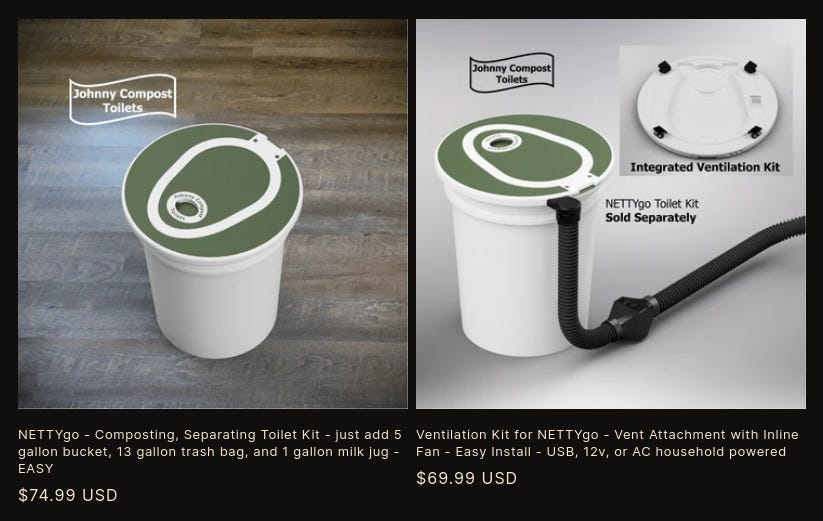
The Nettygo by Johnny Compost Toilets comes with a divider and urine separator. It allows you to convert any 5-gallon bucket into a composting toilet. You put a jug in the front. You put a 13-gallon composting bag in the back. You get the ventilation kit (sold separately). The ventilation hose comes with a fan compartment and a fan. It attaches to the lid, as shown. The lid closes down nice and tidy over the entire configuration.
Next:
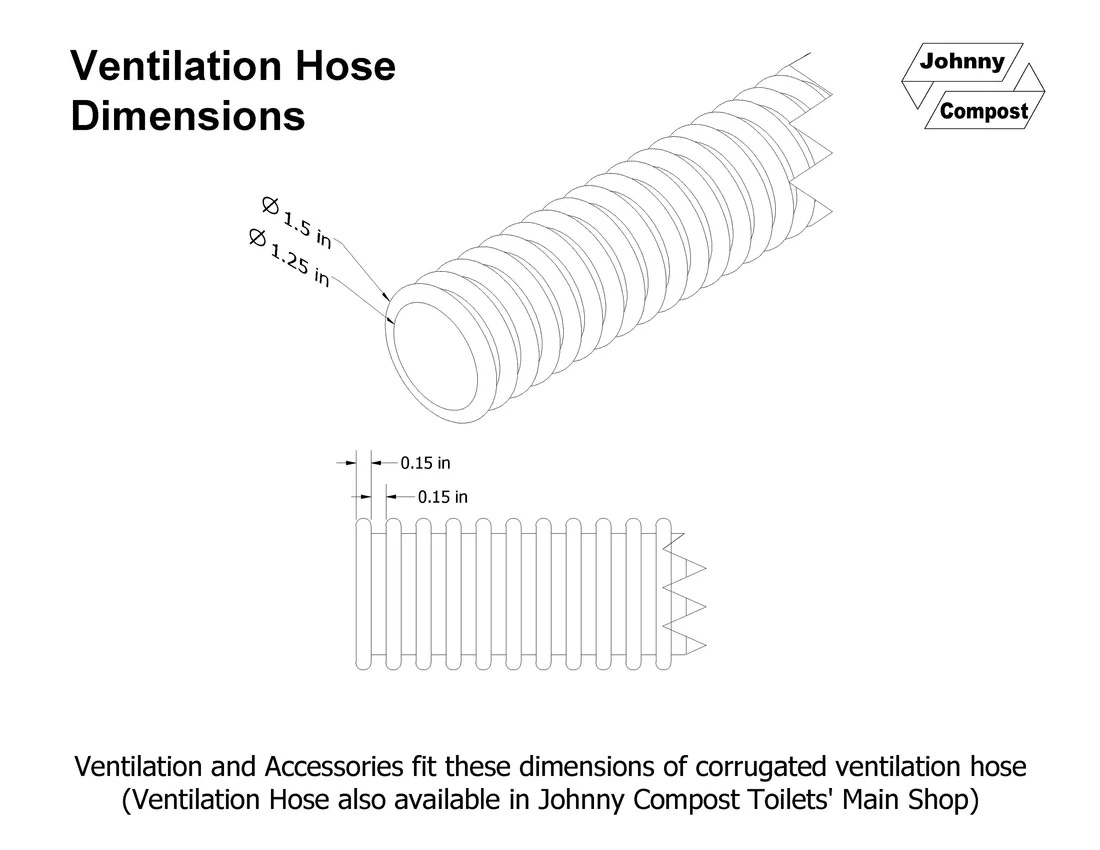
You get a big piece of rigid foam insulation board from your hardware store. You size it to fit your bathroom window. You trace a hole in the foam board, using the hose from the ventilation kit. Or you just cut a 1.5-inch hole in the board with a hole saw, because that’s the outer diameter of the hose:
You follow the instructions to connect the fan to a power source. It involves a minimal amount of wiring.
If you don’t want to buy the toilet, you can follow this basic design and make something yourself. You could even just buy the hose and fan attachment. You can buy your own 60x60x25mm 12V fan, and connect it to an AC/DC converter. You might have to modify the fan attachment, but that’s why god made dremels. You don’t even have to buy anything from Johnny Compost. You can just take the basic idea and source your own parts. But it’s nice to have the option of buying everything you need from one place, and knowing it all fits.
Now you have an emergency composting toilet. It does everything that a fancy composting toilet does. But instead of shelling out a thousand bucks for a composting toilet and permanently modifying your bathroom, you now have something you can set up and take down as needed.
Just remember, drying your waste out isn’t the same as composting it. Drying it out makes it easier to manage. It helps with the smell. You still have to compost it, as described in the steps above.
Why aren’t we talking about these solutions?
Go on YouTube, and you’ll find hundreds of videos about composting toilets by off-griders who live in RVs, tiny homes, and cabins. All of that presents the composting toilet as something incompatible with life in cities and suburbs. That’s not true, it’s just how we’ve been taught how to think.
We thought differently.
We’re still going with our emergency setup, and I ordered the Johnny Composting Kit, to have something one step up from my DIY toilet. I’ll update everyone when it comes and I’ve managed to test it out.
Meanwhile:
Over the last few weeks, I called around and talked to some of the biggest companies that sell composting toilets: Separett; Sun-Mar; Nature’s Head; OGO; Biolet. The consensus is that it’s perfectly feasible to install a permanent composting toilet in a suburban bathroom, no matter where you live.
You can install a composting toilet anywhere. You just need to manage it properly with cover material. If you’re extra skeptical, you can install ventilation kits that come with many of the brands. The ventilation kits help with any lingering odors, but they also help dry out the solid waste.
You might decide to buy a composting toilet with an internal urine diverter. Joseph Jenkins, among many other composters, would tell you that it’s not strictly necessary to separate solids and liquids. But you can, and it makes a big difference with immediate odors and sanitation.
So, you can install a composting toilet with a urine diverter and a ventilation fan. That keeps things extra sanitary in your suburban bathroom.
No odors, no complaints…
Where do you route the ventilation?
If you decide to ventilate your permanent composting toilet:
Ventilation poses challenges.
Most composting toilets will route the ventilation straight through an exterior wall. Some give you the extra option of going through your ceiling. That’s fine for a cabin or a tiny home. It won’t work very well for a home in the suburbs, especially if you anticipate ever selling your home. You can certainly repair a hole, but it’s never going to look the same as before. Depending on where you live, buyers and real estate agents might decide to make a big deal out of it.
We contacted plumbers in our area.
What they said:
You can absolutely design and install an exhaust port for a composting toilet that looks just like a regular dryer vent or bathroom exhaust.
We even came up with a plan to design and 3D print a cover for our vent that matches our existing ports. If we ever have to sell our home, and nobody wants our composting toilet, they would just replace it and then cap off the vents. We wouldn’t have to plug any holes or repair any siding or joists. In short, you spend more on the front end to make the exhaust as unobtrusive as possible, and then you pay very little on the back end if you ever decide to move.
The problem:
You’re routing the exhaust internally, behind your drywall. That requires opening up the drywall, and the ceiling, and that gets expensive. Some homes don't have any bathrooms that accomodate a toilet on an exterior wall, and that poses challenges.
Plumbers quoted us $3,000-$4,000 for that work.
That doesn’t include the toilet.
(So, we're not doing that.)
If you don’t care about your home’s resale value, then just install the toilet with standard ventilation. If you’re confident enough to forego ventilation, then it’s technically not necessary. You empty your composting toilet into your composting heap, follow best practices, and carry on.
It’s that simple.
The short summary:
Odds are, you’re going to need a longterm toilet solution that doesn’t use running water. The alternative is crossing your fingers and hoping the droughts never get bad enough to impact you personally, or that a data center never decides to open up close enough to kill your water pressure. Either way, that’s a rather passive way to approach the climate crisis, and it denies reality.
Composting is the way.
You can do it in the suburbs. You can do it in the city. Composting doesn’t have to remain the domain of farms and homesteads.
You can do it anywhere.
Even if you never use the compost to grow anything, you’re still turning human “waste” into something safe and manageable. You’re not simply creating sewage and then dumping it down a storm drain or letting it fester in a pit somewhere. You’re taking responsibility, and you’re thinking ahead.
So if you’ve ever wondered how you’ll be going to the bathroom in a few years, I hope this post answers some of that uncertainty.
Composting toilets.
That’s how.
Thank you to everyone who reads this unpaywalled newsletter. If you value this content, please help the publication grow by sharing and supporting. I'll always do my absolute best to deliver high-quality, thought-provoking, practical content on a range of issues that matter to us in these unhinged times.
